Perimenopause and caregiving are a mid-career reality rarely captured in data. This analysis examines the cost of Tacere.
The Mid-Career Convergence: Why Menopause and Caregiving Data Collide
Women managing menopause at work are frequently also managing caregiving responsibilities. The combination is not incidental. It is a documented pattern across mid-career and senior professional cohorts that does not appear reliably in workplace data.
The condition described across this series appears here as behavior.
Tacere (tah‑CHEH‑reh) is the sustained, strategic practice of keeping one’s own counsel by a senior executive operating in a professional environment where disclosure carries professional risk. It is not silence. It is a calculated decision.
The choice is rational. An employee managing cognitive symptoms such as difficulty concentrating, memory lapses, or mental fatigue, along with physical symptoms like disrupted sleep and irregular energy, while also managing care for a child, an aging parent, or both, has already determined what disclosure costs. That determination governs what she does next. Accommodation processes require disclosure. Leave entitlement requires a request. Workers’ compensation claims require identification of a covered condition. Each of these mechanisms requires a woman to enter a formal process before any protection applies. The visibility constraint that opens this series has not been resolved by any framework this series examines. It appears here as behavior.
The employee is visible to the people managing her. The decision not to disclose means the data was never created. The system captures only what she produced through an initiating act.
Tacere and the Strategic Logic of Menopause Non-Disclosure
The cost accumulates in ways standard metrics do not capture.
Performance holds because she is managing it.
Capacity erodes without triggering any alert in performance review systems.
The decision to leave arrives without a formal record.
Exit interviews do not capture conditions that were never disclosed.
The departure is recorded, its operating cause is not.
The Michigan Women’s Commission survey documented the disclosure pattern behind that cost. One respondent wrote that she would not discuss any menopause issues with anyone from work under any circumstances. Another described leaving a thriving corporate career, believing she was burned out, only to later understand she had been experiencing perimenopause since her early forties. Her company, she noted, was progressive on equity issues. Menopause was never mentioned. These are not edge cases. They are the pattern the data describes but cannot fully count.
Korn Ferry and Vira Health’s survey of more than 8,000 women found that 74% of women dealing with menopausal symptoms at work do not feel supported by their workplace policies, and only 26% reported having formal policies or programs addressing menopause. Employers responding to that pattern with benefit expansion, leave entitlement, and accommodation frameworks are making real investments. Those investments reach employees who enter the systems built to support them. They do not, however, reach the employees who have already decided not to.
The organization will cite the investment as evidence of action. Employers see utilization but miss the decision not to disclose.
The session was held.
The policy was published.
The benefit was made available.
The activity is logged, and it becomes the evidence.
The organization measured what it offered, it did not measure the utilization.
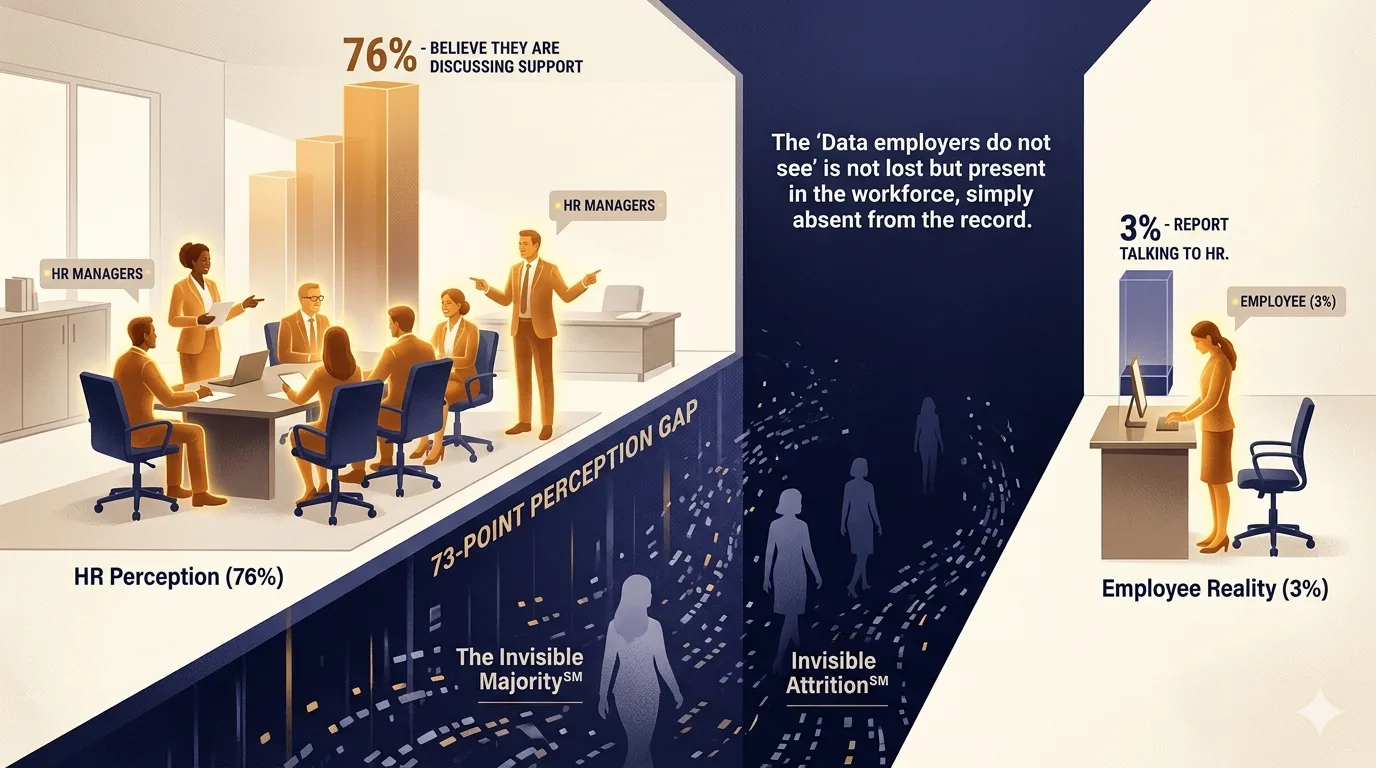
Closing the 73-Point Data Gap: Why Workplace Offerings Are Not Impact
Tacere describes the employees who do not engage. Not because support is unavailable, but because the calculation of risk concludes that the cost of disclosure exceeds the benefit of accommodation. The failure to measure is a choice of architecture, as shown by the 73-point data gap. Just as the New York S7495 study will rely on self-reported data that excludes the decision to remain silent, the corporate investment in benefits relies on utilization rates that ignore the population practicing Tacere. In environments where that calculation is common, the investment does not reach the employees it was designed to include.
Invisible Attrition℠: The Real Cost of the Calculated Exit
She was never silent. She decided.
That decision is Tacere, and the organizational consequence of that decision, accumulating across every instance of the same calculation made under the same conditions, is Invisible Attrition℠, not a related concept, but the governing condition of every data point in this article and every article that precedes it in this series. The cost is not carried by the employee alone. It is absorbed by the organization in retention patterns that register only after she has already left, in a record that will show a departure and nothing else.
No system examined in this series is designed to capture it before it happens.
Read the Disclosure-Independent Performance Protection℠ infrastructure.