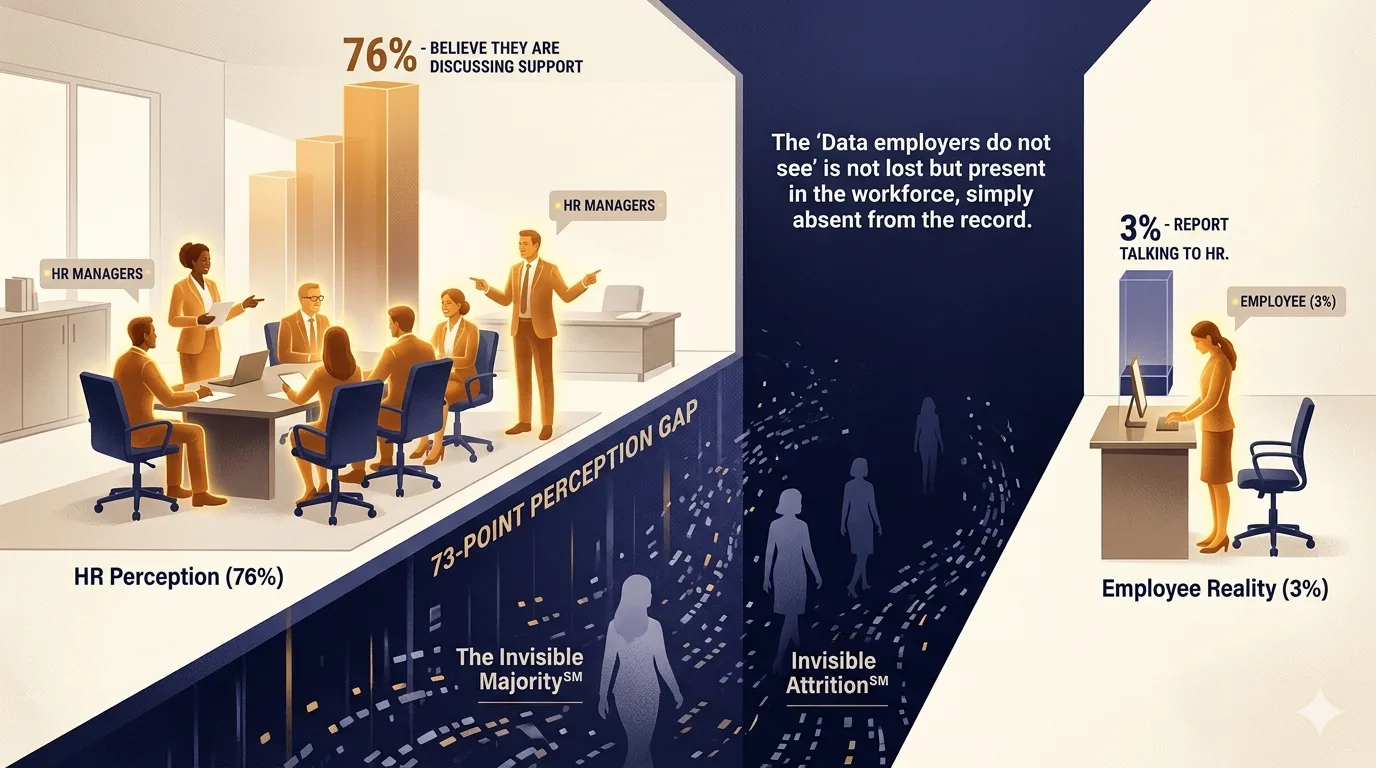
Standard HR metrics from leave requests to benefit engagement capture only what is disclosed. They cannot measure the calculated silence of a leader who views visibility as a professional liability. This analysis explores the "73-point perception gap"
Employers making decisions about menopause support are working from available data. Accommodation requests, leave utilization, healthcare benefit engagement, and manager escalations form the basis for what most organizations can measure. The visibility constraint is the same across all of them: the system cannot measure what it has not been designed to collect. It reflects what employees report. It does not reflect what they do not.
What the Workforce Data Shows
A global survey by Korn Ferry Institute in partnership with Vira Health, covering more than 8,000 women, makes the workforce impact precise.
- 47% reported that perimenopause and menopause-related symptoms disrupted their work performance
- 40% experienced six or more distinct symptoms affecting their effectiveness
- Up to 40% reported missing from a few days to a week of work in any given month
- 28% have quit or considered quitting due to symptoms
- Only 26% reported having formal workplace policies or programs addressing menopause
Only 42% had spoken with their line manager about their experiences, 37% with HR, and only 27% with senior leadership. The majority did not talk — or were not willing to talk — with the people managing them.
These are not outlier responses. They describe a significant share of the workforce: employees who are currently performing, currently impacted, and currently not appearing in the data employers use to assess need.
The 73-Point Perception Gap
A 2023 Bank of America study in partnership with the National Menopause Foundation, surveying 2,000 employed women and 500 HR benefit managers, makes the measurement architecture failure explicit.
76% of HR benefit managers said they discuss menopause with employees regularly or sometimes. Only 3% of peri- and post-menopausal employees said they had talked to HR about it.
That 73-point gap is not a communication failure. It is a measurement system capturing its own activity and mistaking it for impact.
The reasons women gave for not disclosing are not abstract: 32% feared being perceived as old, 28% found it embarrassing, 23% did not want peers to treat them differently, and 18% feared losing the respect of male colleagues. That is a documented professional risk calculation that produces non-participation. The primary reason employers reported not offering menopause benefits was that employees had not asked. The absence of requests became the justification for inaction.
The LiveCareer Working Through Menopause Report (2025), surveying nearly 900 employed U.S. women, confirms the pattern. 97% reported feeling pressured to hide or downplay symptoms at work. Nearly one in three had considered changing jobs, reducing their role, or cutting back on hours — a consideration-of-exit that generated no organizational signal and no record.
Critically, 91% of women begin experiencing symptoms before age 50, the same period many step into senior management. The period of highest physiological disruption overlaps with the period of highest career exposure.
A Tale of Two Exits
Two examples illustrate how this plays out. The financial outcome is the same in both.
In the first, a senior employee exits with no prior signals. Performance reviews were strong. Attendance was unremarkable. Her exit is recorded as personal. Replacement costs the organization up to 200% of her annual salary. The cost was real. The cause was never visible.
In the second, a senior employee exits after increased leave usage, no promotion over multiple cycles, and a lateral role adjustment. Each signal was captured. None was connected to a condition that affects roughly one in ten women who have gone through menopause and left a job because of it. Her exit is also recorded as personal. Same replacement cost. An estimated $2,100 in excess annual healthcare costs absorbed before she left.
Two different data failures. One never captured. One captured and misinterpreted. The financial loss is identical either way.
The Collection-Condition Problem in HR Data
Every tool in the standard employer model activates on the same condition: the woman must produce an initiating act that creates a record. More awareness, more frameworks, and more support options do not change that condition.
The population least likely to engage is the population carrying the highest organizational cost. Senior executives in competitive environments have completed the risk calculation and decided against visibility. That calculation does not become less rational as awareness increases. It becomes more precise. The woman who has read the research knows exactly what the data shows about how disclosed conditions are perceived.
The Korn Ferry and Vira Health survey data confirms this at the career level. Senior executives reported that symptoms had more than twice the effect on promotions, almost three times the effect on hiring decisions, and more than three times the effect on bonuses compared to individual contributors. The women with the most to lose are experiencing the greatest career-level impact — and generating the least data.
What This Hidden Attrition Cost Means for the CFO
The data is not missing. It was never created.
Every accommodation request never filed, every leave day never taken, every exit interview that captured nothing because nothing was ever disclosed — those are not data gaps in the conventional sense. They are the predictable output of a system that requires an initiating act the highest-risk population has decided not to produce.
The record will show utilization. It will show that the conversation happened and the benefits were offered. What it will not show is the woman who calculated the cost of visibility, decided against it, and left.
Use the Retention Calculator to estimate what that departure costs before it appears in the numbers.