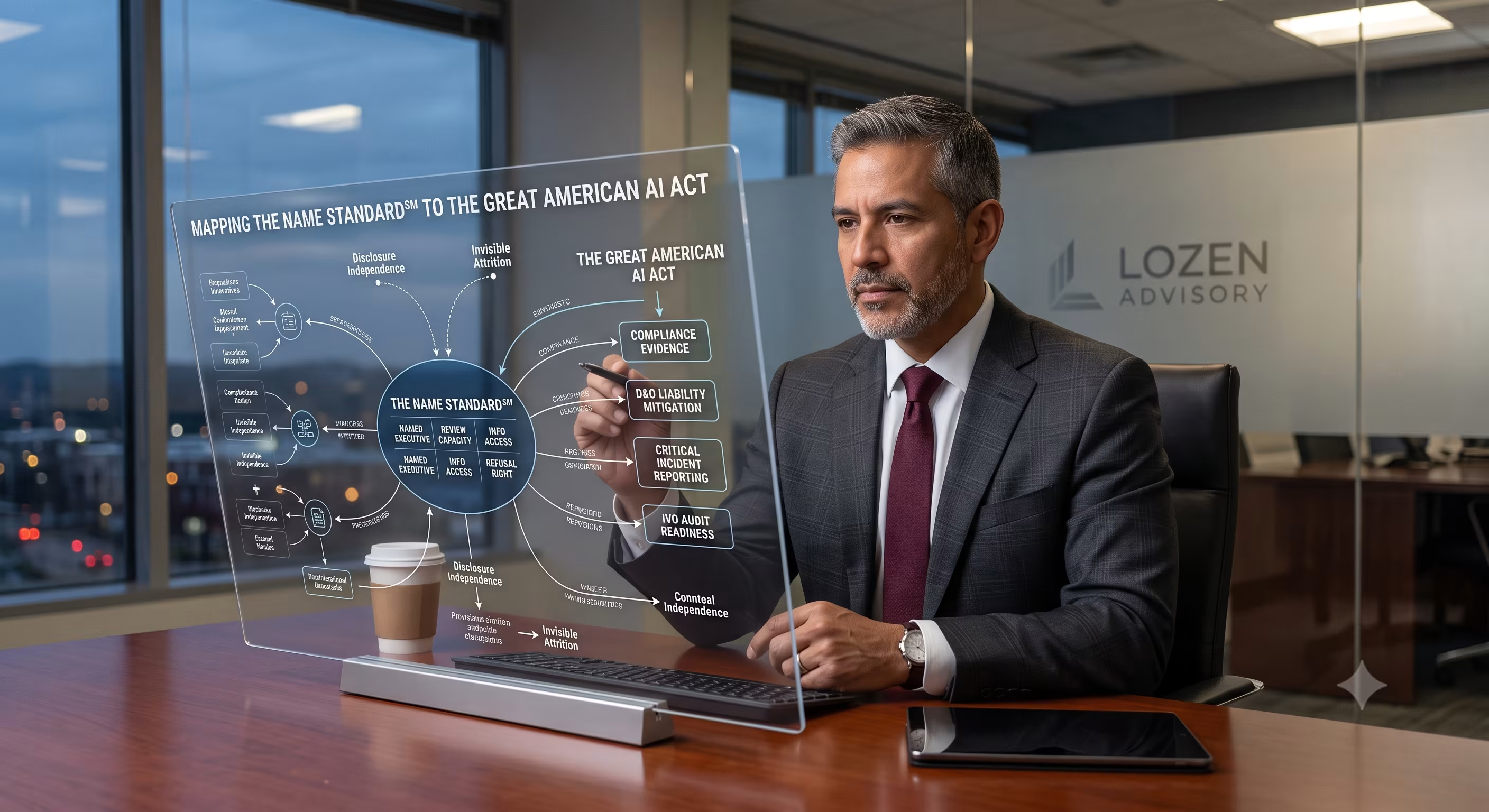
The Great American AI Act discussion draft builds a documentation and verification architecture for AI developers and workforce impact. The Name Standard℠ asks the board-facing question the draft leaves open: who is accountable for interpreting the evidence before deployment?
Congressman Jay Obernolte (R-CA) and Congresswoman Lori Trahan (D-MA) released a discussion draft of the Great American AI Act (GAAIA) in June 2026. Although the draft is framed around frontier AI governance, its board-facing significance is evidence: what must be documented, verified, reported, audited, and measured.
For Lozen Advisory, that places the draft squarely inside Disclosure-Independent Governance℠ — Lozen Advisory’s methodology for identifying systemic risks that legacy measurement systems are structurally blind to. The Name Standard℠ is the part of that methodology that asks whether evidence can be traced to a responsible human or institutional actor.
Sections 101 through 123 build a documentation-and-verification architecture for large frontier developers: written frameworks, pre-deployment risk reports, critical safety incident filings, independent audits, and model documentation templates. Sections 241 through 257 build a parallel evidence architecture for workforce impact: AI-attributed layoff disclosures, occupational forecasts, and federal survey data on AI adoption. Both halves of the bill are asking the same underlying question from opposite directions: what happened, and can it be proven?
Why this matters to board-facing AI governance teams
Board-facing AI governance teams inside a large frontier developer, or inside a company whose workforce is being reshaped by AI adoption, will increasingly be responsible for producing and explaining the outputs this bill requires: a frontier AI framework, an Independent Verification Organization (IVO) oversight model audit to understand, a critical safety incident report, and a WARN Act disclosure reviewed as part of workforce-risk oversight.
The Great American Artificial Intelligence Act discussion draft is thorough about what must be produced and by when. It is comparatively silent on who inside the organization has assigned review time, technical access, decision authority, and subject-matter competence to interpret that evidence. That is where the Name Standard℠ becomes useful: it does not replace the bill’s compliance architecture. It sits underneath it, asking whether the organization has a named accountability structure capable of producing evidence the board can rely on.
Mapping the Name Standard℠ to the GAAIA discussion draft
| Name Standard℠ pillar | GAAIA provision | Board-facing evidence question |
|---|---|---|
| Time allocation | Critical safety incident reporting — Sec. 111 | Large frontier developers must report a critical safety incident to CAISI within 15 days, or within 24 hours if the incident poses an imminent risk of death or serious injury. That clock only works if review time is staffed and allocated in advance. The board-facing evidence question is whether the organization has named reviewers positioned to meet the deadline before an incident occurs. |
| Review capacity | IVO audits and catastrophic-risk mitigation — Sec. 112 | CAISI-licensed Independent Verification Organizations audit whether a developer’s framework achieves acceptable levels of catastrophic risk mitigation. The audit creates external verification evidence, but it does not answer whether the organization has the internal capacity to understand, challenge, explain, and act on what the audit finds before it reaches the board. |
| Information access | Synthetic content detection and deployment disclosure — Sec. 102 and Sec. 111 | CAISI is directed to support synthetic content detection tools, and deployment reports must disclose intended use, restrictions, risk assessments, and mitigation steps, subject to redactions. Those provisions create evidence channels, but they do not necessarily give board-facing teams full visibility into every underlying model dependency, vendor relationship, or deployment context. |
| Documentation infrastructure | Model documentation templates — Sec. 123 | NIST’s pilot template standardizes what gets documented, including model name, developer identity, release date, training data cutoff, supported languages, terms of service, technical guidelines, and performance metrics. This creates infrastructure for capturing evidence, not infrastructure for assigning accountability for what the evidence shows. |
| Formal right of refusal | Internal pause, restriction, remediation, or rejection authority | No section of the discussion draft appears to establish this as an internal governance right. Sec. 113 protects employees and contractors from retaliation after lawful reporting of AI-law violations. That is not the same as giving a named internal actor standing authority to pause, restrict, or reject deployment before harm occurs. |
Lozen Advisory applies this same Name Standard℠ mapping to other AI legislation. For the AI AGENT Act analysis, see How the Name Standard℠ Maps to the AI AGENT Act
The Lozen Advisory view
Four of the five Name Standard℠ pillars have at least a partial institutional home in this draft. The fifth does not.
A framework can be written, reviewed, and audited. A deployment report can be filed with substantial information access. A documentation template can be completed correctly. But none of those requirements, by themselves, identifies the person or role with standing authority to stop, restrict, or remediate a deployment before the evidence becomes an incident report.
Sec. 113 creates anti-retaliation protection for employees and independent contractors who lawfully report violations of federal AI law. In the Name Standard℠ mapping, that matters because whistleblower protection is not the same as pre-deployment refusal authority. The draft protects a reporting pathway, but it does not appear to establish a named internal role with standing authority to pause, restrict, or reject deployment before the risk materializes.
Lozen Advisory’s Board AI Name Standard Advisory evaluates whether AI-assisted decisions remain attributable, reviewable, and supported by evidence the board can rely on.