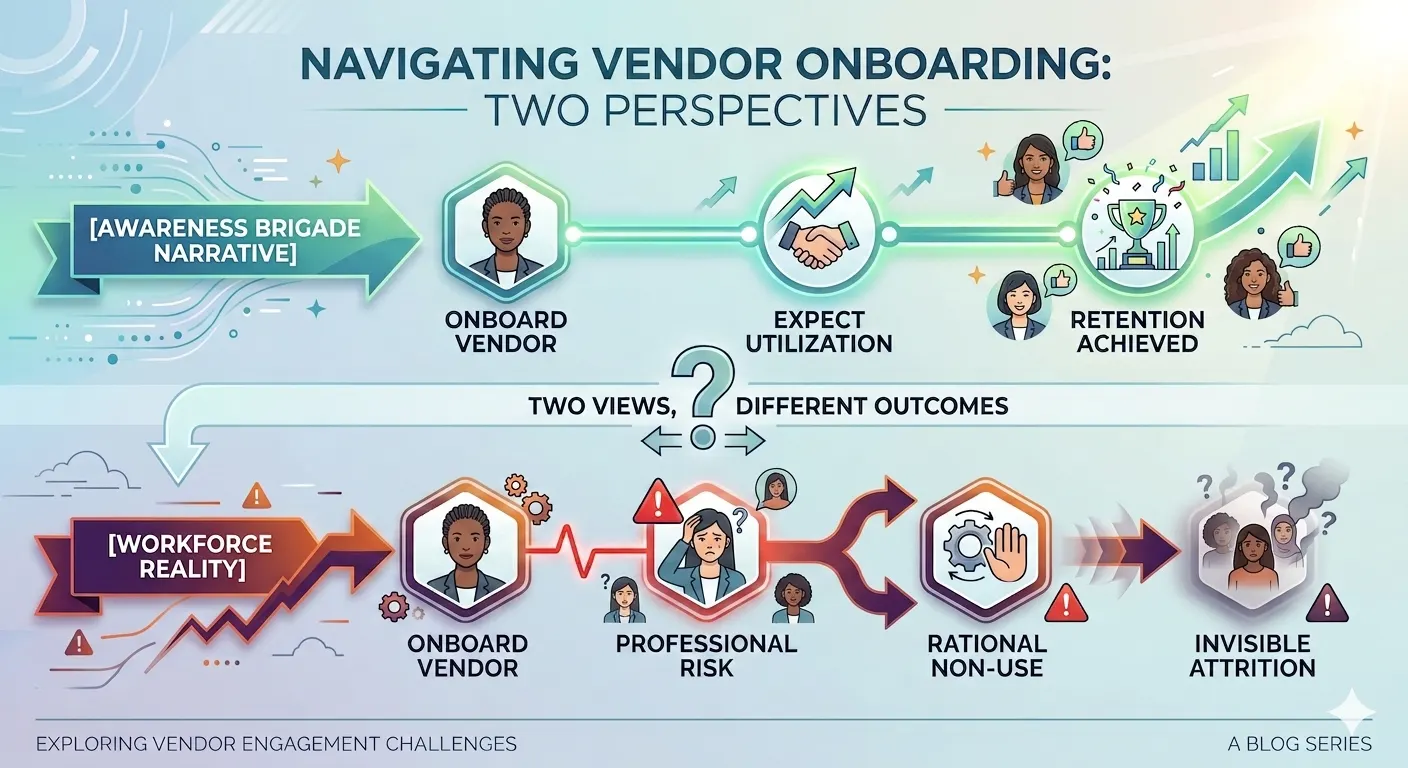
The corporate benefits landscape is currently dominated by what can only be described as the "Awareness Brigade." Recent industry reporting, such as NFP’s specialized leave metrics published by HR Dive, routinely scolds the market for a lack of supply, characterizing the slow rollout of midlife health programs as a "missed opportunity" for employers.
The $600 billion women’s health market that PwC forecasts by 2030 is real. The employer adoption surge it describes, from 4% to 25% of enterprises offering dedicated menopause benefits, is real. PwC’s diagnosis of why utilization remains low is also stated clearly: employees do not know these benefits exist or how to access them.
That diagnosis is wrong. And organizations building strategy on it are investing in the wrong fix while the attrition continues.
What the forecast does not measure is whether awareness works. Awareness mantras are loud in the market but they are based on assumptions not data.
Boards and General Counsel cannot make decisions in this realm without closer examination of the facts.
Supply & Demand?
PwC’s analysis is tracking supply. Employers are purchasing benefit packages; vendors are expanding; the category is growing. By every market metric, the menopause at work problem has a perfect solution.
However, utilization data tells a different story. Adoption rates among eligible employees remain in the single digits across most enterprise programs. The senior women these benefits are designed to retain are not using them. Demand has not materialized.
This is not a program awareness gap. Lozen Advisory’s research on Invisible Attrition℠ establishes that non-use among this population is structurally rational: using a company-sponsored menopause pathway requires initiating disclosure, and disclosure introduces professional exposure the employee is unwilling to absorb. The benefit exists. The structural barrier to accessing it also exists.
The benefit exists in theory. The professional cost of using it exists in practice. The gap between what the benefit offers and what accessing it costs is where silence is produced.
The Gap Between Market Signal and Organizational Reality
PwC acknowledges the utilization problem directly. Its payer and employer section notes that utilization remains limited and prescribes the fix: invest in education and navigation so employees know what exists and how to access it. That is an awareness diagnosis that locates the failure in communication.
However, Lozen Advisory’s research on Invisible Attrition℠ locates the failure elsewhere. The senior women these programs are designed to retain are not avoiding them because they are unaware. They are avoiding them because using a company-sponsored menopause pathway requires initiating disclosure, and disclosure introduces professional exposure they are unwilling to absorb. More education does not change that calculus. Better navigation does not change that calculus. The structural barrier is the disclosure dependency itself.
PwC’s prescribed solution, investing in education and navigation to drive engagement, will produce engagement data without producing retention outcomes. The programs will appear more utilized. The attrition they were purchased to prevent will continue.
An awareness campaign addresses the wrong problem. The women who know about these benefits and aren’t using them are the exposure.
The Governance Problem PwC Market Data Hides
When an organization responds to PwC’s market forecast by purchasing a benefit, then reports that benefit in ESG disclosures, investor materials, or talent strategy updates, it is making a representation. That representation is that the organization has meaningfully addressed attrition risk among senior midlife women.
The internal utilization data does not support that public representation.
General Counsel should be asking a specific question: does the gap between what the organization claims to have built and what senior women are actually using constitute a substantiation exposure? In most cases, it does. The benefit is listed and the utilization is invisible. However, the departure data, which eventually shows the true attrition pattern, surfaces only after the loss.
The board faces the same structure from a different angle. Succession and continuity risk concentrate inside a narrow population of senior talent. When the tools designed to stabilize that population are functionally unused, the organization’s continuity measurement is incomplete. The board is being asked to make governance decisions with information that does not reflect operational reality.
What the PwC Market Correction Actually Names
The CFO-level reckoning that is now working through corporate benefit budgets, documented in Lozen Advisory’s market correction analysis, identifies this as a capital allocation failure. Purchased benefit seats that generate no utilization, are sunk cost.
But the governance exposure sits above the CFO problem. Boards and GC are not primarily concerned with vendor spend. They are concerned with whether the organization’s stated position on talent retention reflects what the organization can actually demonstrate.
PwC’s forecast confirms that the market believes midlife women’s health is a retention lever. Lozen Advisory documented the fact that this belief has not been tested against the structural reality of how these programs fail on utilization metrics. That gap, between the market’s assumption and the organization’s operational evidence, is what boards and General Counsel are now positioned to inherit.
The question is whether they inherit it before or after the attrition it fails to prevent becomes visible.
What the Board and General Counsel Should Be Able to Answer
- Verification of Professional Exposure: Does the current benefit pathway require an upfront professional paper trail? If access or specialized leave requires an employee to explicitly flag symptom status to a manager or vendor dashboard, the architecture forces a disclosure dependency that triggers rational non-use.
- Efficacy Metric Alignment: Does the infrastructure measure engagement logs or genuine risk mitigation? A vendor dashboard showing high click rates does not prove leadership capacity has been stabilized. Compliance documentation must tie capital deployment to retention, not portal traffic.
- Accounting for Structural Silence: Does the risk model account for workers managing their health entirely outside the corporate viewport? If the enterprise has no mechanism to support the silent tier of senior talent, the organization’s continuity tracking remains fundamentally incomplete.
This analysis applies Invisible Attrition℠ to the market conditions documented in PwC’s 2026 Unlocking The Menopause Market Forecast.