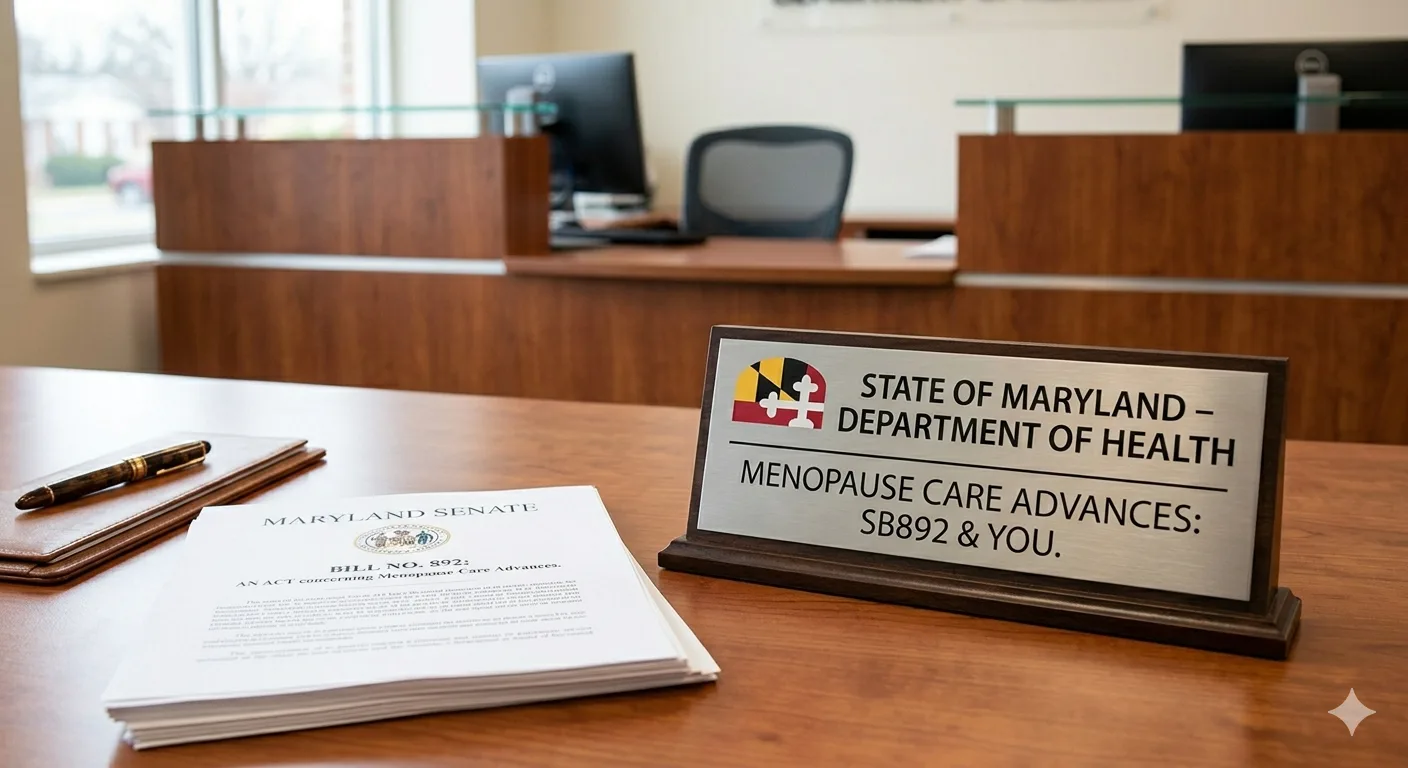
Maryland SB892: The Limits of Menopause Mandates. The legislation improves training. It expands coverage. It strengthens the clinical system at the point of care. But it does not alter the condition that governs entry into HR systems.
Status Note June 2026 — Enacted Legislation
Executive Update (June 6, 2026): Maryland SB892 has been enacted as Chapter 605 after approval by the Governor on May 26, 2026. This article is retained as an analysis of the model Maryland adopted: provider training, insurance coverage, policy initiatives, and access-to-care mechanisms rather than a direct employer-facing workforce-rights framework. The bill is important to the national landscape, but it is not Lozen Advisory’s primary legislative lane because it does not create an employer/workforce activation mechanism.
Maryland’s Senate passed Senate Bill 892 by a vote of 41 to 0. The House followed at 135 to 2. The bill enrolled on April 8, 2026.
Those numbers are worth reading before examining what the legislation does, because they say something the bill text does not. A near-unanimous vote on a menopause bill is not movement on a marginal issue. It is confirmation that the condition the bill addresses has reached systemic recognition. Maryland SB892 is the most recent state to act on menopause at work through the clinical and insurance access layer.
SB892 operates at the clinical and insurance access layer. It does two things. It requires health occupations boards to grant at least two continuing education credits for every one hour of menopause-specific training completed. It also requires insurers, nonprofit health service plans, and health maintenance organizations to cover the evaluation and management of menopause and menopause-associated conditions.
Both provisions respond to documented failures in the clinical system. Both improve what happens once a woman seeks care. Neither addresses the condition that determines whether she enters that system at all.
Every mechanism in SB892 assumes an initiating step: that she engages, that she discloses her symptoms, and that she can pursue a clinical pathway without professional consequence.
Addressing the Menopause Clinical Training Gap
The training gap SB892 targets is structural, not incidental.
A 2016 perspective in the New England Journal of Medicine documented a decade-long pattern following the 2002 Women’s Health Initiative study: hormone therapy use dropped by as much as 80%, and internal medicine residents reported low confidence managing menopause despite identifying it as a core training priority. The findings of that study were applied beyond the population it was designed to evaluate, producing a collapse in use and a generation of physicians trained inside that avoidance pattern.
The FDA’s November 2025 removal of black box warnings on hormone replacement therapy products formalized what the clinical literature had already corrected. SB892 is being built on that updated record, not the one that produced the gap.
Maryland’s response is an incentive mechanism. The 2:1 credit structure increases the return on menopause-specific training without requiring boards to restructure. It shifts provider behavior without redesigning the system.
A 64-credit menopause program from Harvard Medical School and Massachusetts General Brigham exists because standard clinical training has not produced competency at scale. SB892’s multiplier is designed to accelerate uptake of that existing supply.
Expanding Insurance Coverage for Menopause Care
The coverage requirement addresses a separate access point. Women seeking menopause care have historically encountered two barriers in sequence: a provider without adequate training, and an insurer without a coverage obligation. The insurance provision removes the second barrier. It does not resolve the first, but it eliminates the financial constraint for those who have already located a knowledgeable provider.
Both provisions operate at the same layer of the problem. Both address what happens after a woman enters the clinical system and seeks care. Both assume the initiating condition: that she has engaged, that she has disclosed her symptoms, and that she has the professional circumstances to pursue a clinical pathway without cost to her standing. Those conditions are not professionally neutral for women in leadership. They are shaped by the risks attached to disclosure in environments where performance is continuously evaluated. That constraint, and how it governs entry into formal systems, is examined in the structural silence framework.
Structural Limits of Menopause Legislation and Healthcare Access
The limits of that reach operate on two dimensions.
The first is the market that formed in the absence of clinical care. Demand did not disappear. It reorganized into a parallel market that captures women before they ever enter the clinical system. That market is reinforced through repeated exposure and algorithmic targeting once a woman engages even once. As Dr. Nanette Santoro, an OB-GYN professor at the University of Colorado Anschutz, told the Associated Press in March 2026, the marketing has become very aggressive and pervasive.
Better-trained providers do not displace that market. They enter into competition with it, including the systems that have already shaped patient perception and demand. The second dimension is structural. Engagement is not automatic, it is initiated and carried by the patient.
Evidence shows menopause care is often prompted by patient request rather than integrated into standard care pathways. Women must recognize symptoms, decide to act, and persist through incomplete or dismissive encounters. Care is frequently siloed. Clinicians may attribute symptoms to other causes before considering menopause. Across studies, dissatisfaction with care remains high even among women with access.
The burden of navigation sits with the woman. SB892’s training provision is designed to improve what she encounters when she engages. It does not reduce what it costs her to get there. For some women, that cost is informational. For others, it is experiential, shaped by prior interactions with the healthcare system.
For Black women, that barrier is compounded. Preliminary findings from the Black Women’s Health Imperative survey of more than 1,500 U.S.-based Black women found that:
- 52% did not know which medical recommendations to follow
- 46% lacked adequate information to manage symptoms
- 43% reported discrimination or unfair treatment when seeking care
The population studied was educated, insured, and professionally active. Access to a system and confidence in that system are not the same condition.
A woman who anticipates dismissal or inequitable treatment has already made a calculation about whether engagement is worth the cost. That calculation is where the limits of SB892 become visible.
The legislation improves training. It expands coverage. It strengthens the clinical system at the point of care. But it does not alter the condition that governs entry into that system. The decision to engage is not neutral. It is a cost calculation shaped by information, experience, and professional context. SB892 operates only after that calculation has been made.
That pre-engagement condition is where Invisible Attrition℠ begins: the erosion of performance and capacity that occurs before any formal system detects risk, and before any legislative framework is able to respond.