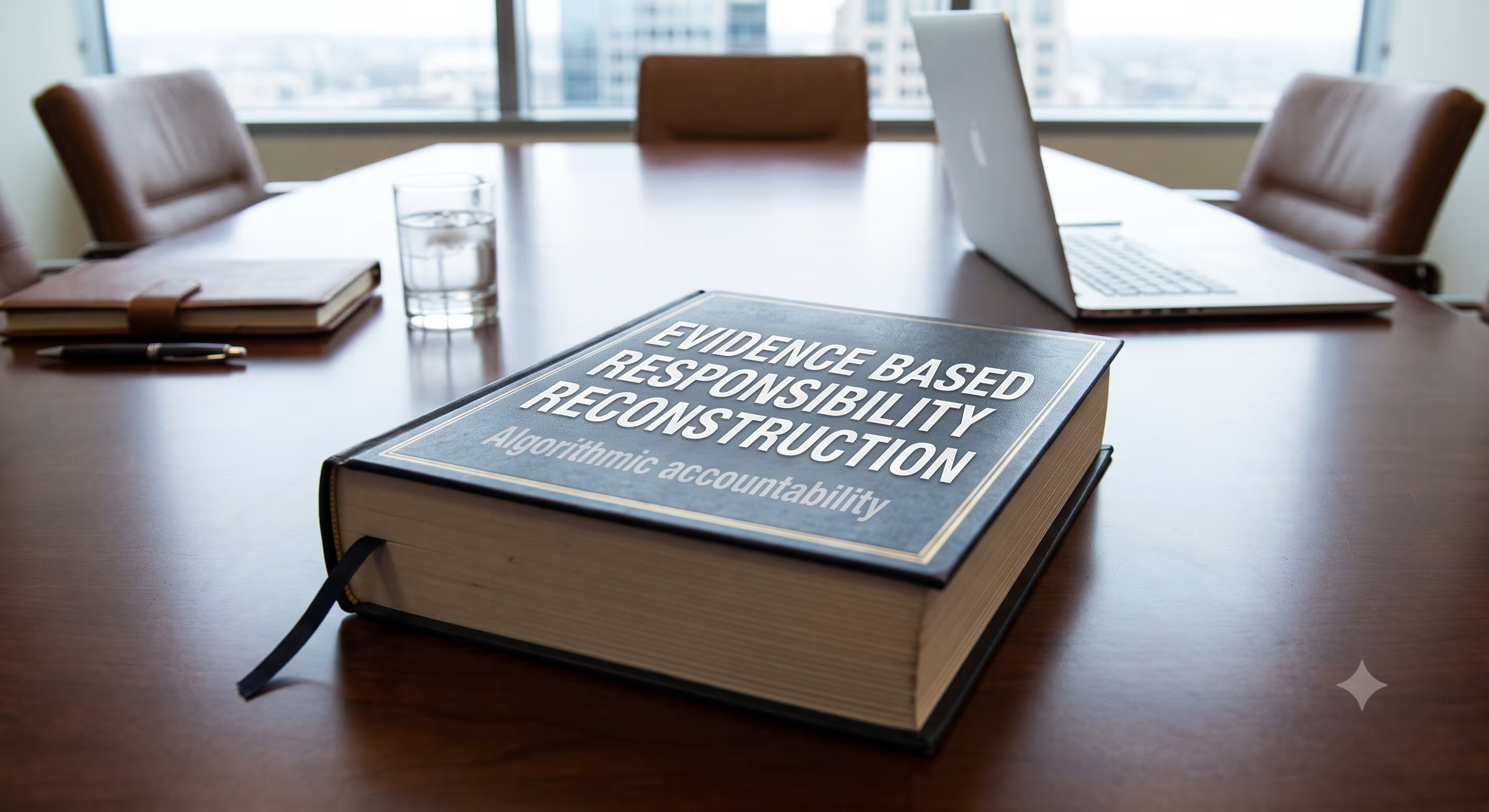
When an organization cannot show how AI-assisted work moved from generation to reliance, market-facing productivity claims morph into an active disclosure-control problem.
Companies are telling boards, investors, and the market that AI is improving productivity, reducing cost, and transforming operations. The real question isn’t whether AI can generate more output. It’s whether the organization can prove how that output entered the business record — and the same evidentiary gap is now surfacing across law, insurance, recruiting technology, and enterprise coding agents.
That is the AI disclosure-control problem. It is also why shadow AI belongs inside Disclosure-Independent Governance℠: the issue is not only tool use, but whether the institution can reconstruct the evidence chain when AI-assisted work enters the formal record.
If the organization does not know whether the final work product, when generated by AI, followed the company’s data governance business rules or QA processes before reliance, the productivity claim is weaker than it sounds.
Tool use is not proof. Output volume is not proof. Adoption is not proof. AI governance begins where adoption metrics stop.
Shadow AI Is a Record Verification Problem
Shadow AI is usually treated as a cybersecurity issue. That framing is too narrow. It is also a record problem, an accountability problem, and a Disclosure-Independent Governance℠ problem.
The issue is not only that employees are using unapproved tools. The issue is that AI-assisted work can enter the business record without a usable evidence chain. The organization may see the finished memo, analysis, summary, board material, legal draft, financial model, or customer response. It may not be able to reconstruct what tool was used, what information was entered, what output came back, what was changed, what was verified, or whose judgment attached to the final work product.
The current market data makes the gap harder to dismiss. A TrustedTech / Censuswide study of 2,001 UK and US employees found that 48% use unapproved AI tools at work. The pattern is most concentrated at the top of the organization: 65% of decision-makers reported using shadow AI, compared with 31% of employees below decision-maker level. At the C-suite level, the figure rises to 72.8%.
That changes the risk frame. Shadow AI is not merely a junior-employee compliance problem. The same study found that 76.5% of employees recognize security or data-privacy risks in unapproved AI use, yet usage remains widespread. Nearly one in three employees said they would keep using AI tools even if banned and risking disciplinary action, rising to 37.1% among decision-makers. That is not ignorance. It is an incentive structure.
An Okta-commissioned survey shows the same disclosure-control problem from another angle:
- 90% of executives were confident in their organization’s visibility into AI tools
- 52% of knowledge workers admitted using unapproved tools
- 58% of executives reported an AI-related security incident or close call in the prior year
This is executive confidence sitting on top of hidden use and undisclosed risk.
When an employee or executive uses an unapproved tool and says nothing, because the incentive is to deliver output rather than flag how it was produced, the organization loses the evidence chain. At that point, the problem is not that someone used the wrong tool. The problem is that the organization may be relying on a record it cannot reconstruct, because the record was never created.
This is where the Name Standard℠ becomes operational. If AI-assisted work entered the record, the governance question is not only whether the tool was approved. The question is whether the organization can identify who relied on AI, and whose authority is attached to the final output.
The Near Miss Is a Control Signal
A near miss is not implementation noise. It is evidence that AI-assisted work could have entered the business record without a hint of compliance.
In most organizations, the employee who caught the error was the power user: the person most fluent in the tool’s failure modes, most capable of recognizing when output required correction before reliance. That labor is not measured, has no line item, and does not appear in the productivity dashboard. But it is the reason the near miss was a near miss and not a material error.
If the organization cannot say who had authority to stop the output, who documented what happened, and whether that employee’s judgment was the only control between generation and reliance, it does not have AI governance. It has an AI policy with gaps in it, and a narrow group of employees quietly filling them.
A company cannot credibly claim AI improved productivity if it cannot explain what was generated, what was reviewed, what was corrected, and what human labor made the output usable.
AI Evidence Lacks a Chain of Custody
The disclosure-control problem is not theoretical. In each of the following cases, AI-assisted work entered an institutional record before the organization could substantiate how it got there.
U.S. Department of Justice (April 2026)
- A former assistant U.S. attorney was fired after a court found fabricated quotations and misstatements of case holdings in a government brief he signed
- He initially claimed he filed an unfinished draft; he later admitted he felt panicked, had AI rewrite a lost version, and filed it believing he had reviewed it
- The court called the conduct “particularly odious” given the trusted position involved
- The verification layer collapsed under production pressure
Sullivan & Cromwell (April 2026)
- Sullivan & Cromwell apologized to Chief Judge Martin Glenn of the U.S. Bankruptcy Court for the Southern District of New York for an emergency motion containing approximately 28 erroneous citations
- The firm publicly disclosed it had comprehensive AI governance policies, two mandatory training modules, and explicit verification requirements
- This is the clearest documented example of the gap between AI governance as written policy and AI governance as operational reality
Gordon Rees Scully Mansukhani, LLP
- An Am Law firm with $759 million in gross revenue apologized for AI hallucinations in a bankruptcy filing and published new AI governance policies
- Four months later the firm filed another hallucination-riddled brief in a separate matter
- The policy announcement did not reach the verification layer; nothing did
In each case the organization could not substantiate how the work was produced, what was verified, or who was accountable before the output moved. That is not an LLM hallucination problem, it’s a disclosure-control problem.
AI Recruiting Platforms: Why Explainability Is Not Evidence
Industry reporters covering recruiting technology are now asking a version of the same question this piece has been building toward: can a job board or recruiting platform explain how an AI-generated candidate ranking was actually reached — not that it was produced, not that it correlates with hiring outcomes, but why this candidate scored above that one.
The framework from Algorithmic Accountability Needs a Room of Its Own gives that question a precise answer. A recruiting platform that can name which model ran, which job requisition it scored against, and which recruiter relied on the output is, at best, attributable only. A name and a process can be connected to the ranking, but not why it was reached or whether a qualified candidate was scored down for reasons no one can recover.
AI productivity claims become a disclosure-control problem when the organization cannot show how AI-assisted work moved from generation to work product or evidence.
It gets worse if the system is asked to justify itself. A model that generates a plausible-sounding explanation for its own ranking, after the fact, is not producing independent evidence of its reasoning. It is a case of self-attested evidence failure: the witness and the defendant are the same entity. A justification generated by the same system that produced the ranking cannot verify whether that ranking was free of hidden bias, flawed disposition data, or a prompt-injected instruction. It can only generate a second output that sounds like an answer.
Recruiting technology is now arriving at the same diagnosis already visible in coding agents, legal drafting, and insurance underwriting: the AI governance failure that matters is not adoption or output volume. It is evidence.
Why Quarterly AI Governance Fails AI Speed Test
Many organizations are governing AI with systems built for slower work. A committee meets. A policy is approved. A training module is completed. A dashboard shows adoption. Meanwhile, AI-assisted work is happening continuously across teams using different models, prompts, data inputs, and review standards.
That creates a timing problem. Quarterly governance cannot prove minute-to-minute control. Conventional wisdom treats the policy layer as the governance layer; in contrast, the control problem lives at the point where AI output becomes business work, and that point is never on the committee’s agenda.
The Power User Trap℠ operates precisely here. The employees absorbing the verification burden are not flagging it; they are performing. And performance masks the condition, Invisible Attrition℠, producing withdrawal until the capacity is gone and the organization has no language for what it lost.
The Disclosure-Control Question for General Counsel
AI productivity claims require evidence. The organization needs to be able to answer: which tools are actually in use, including unapproved ones; who reviewed AI-assisted output before it entered a board-facing, legal, financial, recruiting, or workforce record; what near misses were caught before reliance; what human verification labor was required to make the output usable; and who had authority to challenge or stop the AI-assisted recommendation before it became a business decision.
That last question is the one disclosure-dependent systems cannot answer. If the organization cannot answer those questions, the issue is not messaging; it is control. This is the operating gap Disclosure-Independent Governance℠ is designed to identify: the distance between what the institution can document and what the institution is actually relying on.
Board AI Algorithmic Accountability
Related AI Workforce Materiality Articles
- Mandatory AI Use Is Not AI Governance
- AI Investment Is Scaling Faster Than Human Capacity
- LLM Generation Is Fast. Governance Is Not
- AI ROI & The CFO: The Hidden Costs of Correction and Rework
- Beyond the 10-K: Mitigating AI Governance & Workforce Risks
Organizations confronting unsupported AI claims, evidence gaps, or activated disclosure scrutiny can use Lozen Advisory’s Board AI Algorithmic Accountability service to reconstruct the record and clarify accountability.