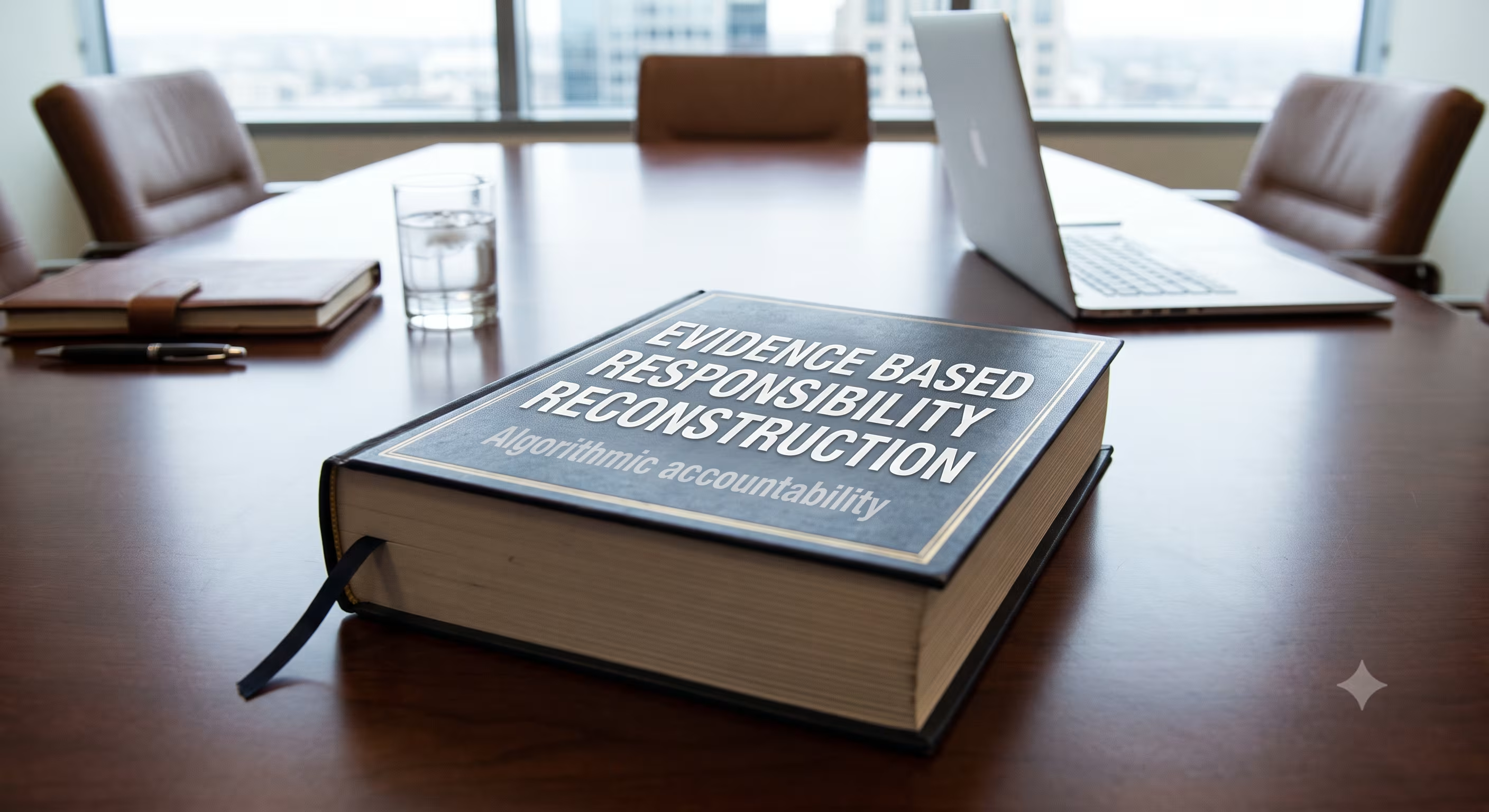
Language models simulate coherence, not truth. When executives eliminate human capacity to prove AI ROI, they don't eliminate the work, they just force it into a structural blind spot.
New workforce data reinforces the risk identified in this article. Adaptavist’s 2,500-person survey across the UK, US, Canada, Germany, and Spain found that one-third of knowledge workers are considering moving to a different industry because of AI concerns, while more than one-third said AI has made them think about retiring earlier. Separately, Jeff Bezos argued at VivaTech 2026 that AI may create labor scarcity rather than eliminate the need for human labor.
These signals are not contradictory. They point to the same governance problem: AI adoption may increase demand for judgment and human capacity at the same time it makes experienced workers less willing to remain inside these organizations. The risk is not only whether AI replaces tasks, the risk is whether companies destabilize the people who make AI output usable, defensible, and institutionally safe.
When AI Adoption Replaces Governance
In January, Snowflake CIO Mike Blandina cut his engineering team to its year-end headcount target — ten months early. He described it as a “provocative way” to force AI tool adoption. His logic was direct: remove enough people, and the team will either use the tools or fail.
That is not an AI governance strategy. It is a pressure test dressed as one.
Blandina’s team is now smaller, under explicit pressure to produce with AI assistance, and operating inside an incentive structure where flagging a bad model output carries visible professional cost. The organization will see throughput. It will not see the verification labor that throughput required. It will not see who absorbed the doubt — and it will not see who is practicing Tacere, keeping silent about what the tools cannot do because visibility carries the risk of losing their job.
What happens when leadership tests AI productivity by removing human capacity before proving what the technology actually replaces?
This is the measurement problem that matters for CFOs right now — not whether AI tools produce output, but whether organizations have any infrastructure to govern what that output costs, who is responsible for it, and where the liability lives when it is wrong.
Most do not. And the gap is not in the model, it is in the workforce buzzwords and systems wrapped around it.
The Rehiring after Firing Signal: Canary in the Coal Mine?
The Snowflake experiment is not an outlier. It is a pattern — and the pattern is already reversing. Employers who laid off workers citing AI are already starting to regret it. Research by Forrester indicates that 55% of executive decision-makers regret their AI-driven staff cuts, with many businesses finding that AI is better suited to assist rather than replace humans. According to, The Forrester AI Job Impact Forecast, US, 2025–2030, “over-automating roles due to the hype surrounding AI can lead to costly pullbacks, damaged reputations, and weakened employee experiences.” Forrester’s ++2026 future-of-work predictions++ further reveal that over half of layoffs attributed to AI will be quietly reversed as companies realize the operational challenges of replacing human talent prematurely.
The problem is not executive enthusiasm for AI. The problem is executive imitation without measurement.
Two in three organizations that cut staff because of AI are already rehiring those workers, according to a February 2026 Careerminds study of 600 HR professionals. More than half began rebuilding within six months. Nearly one-third had rehired between a quarter and a half of all eliminated roles.
The reasons are instructive. More than half of HR leaders said AI required more human insight than anticipated. Just 21 percent said AI had fully replaced roles without operational issues. And more than 55 percent acknowledged that reskilling and redeployment were never formally discussed before the cuts were made.
Gartner has projected that by 2027, half of companies that attributed customer service headcount reductions to AI will rehire staff to perform similar functions. Forrester was blunter: it expects half of AI-attributed layoffs to be quietly reversed.
LLMs are being used to justify headcount cuts, while creating the next cost-control problem.
What Is the Price of Doubt in Enterprises?
The organizations that struggled most were, by Careerminds’ own account, making irreversible decisions without the full picture. What that report does not name is the verification labor accumulating inside the Power User Trap℠ — the informal, unmeasured human absorption that keeps AI output usable but carries no line item on the balance sheet and requires no disclosure event to exist.
Language models simulate coherence, not truth.
This is what LLM governance looks like when it is not governed: unpriced, invisible, and concentrated inside the employees an organization can least afford to lose.
The Token Cost Mirage: Runaway Spend and Structural Shifts
The token-cost problem is exposing a rift in the AI Hype Cycle. By June 2026, the executive mood has shifted from unmeasured enthusiasm to a deep anxiety over runaway costs and unquantified operational shifts. High-profile enterprise failures such as Uber exhausting its entire annual AI budget in a matter of months due to surging code-assistant usage, have proven that raw model utilization is a financial liability when decoupled from human governance. While legacy software providers scramble to sell multi-million dollar dashboards to route models and cap individual employee token usage, they are treating a human capacity crisis as a software optimization problem. Capping tokens does not reduce the hidden verification burden shifting onto your highest-judgment senior leadership; it merely masks it.
Lozen Advisory’s AI Workforce Materiality Briefing examines whether AI productivity claims omit the verification labor, judgment burden, and institutional capacity required to make AI-generated work reliable.